
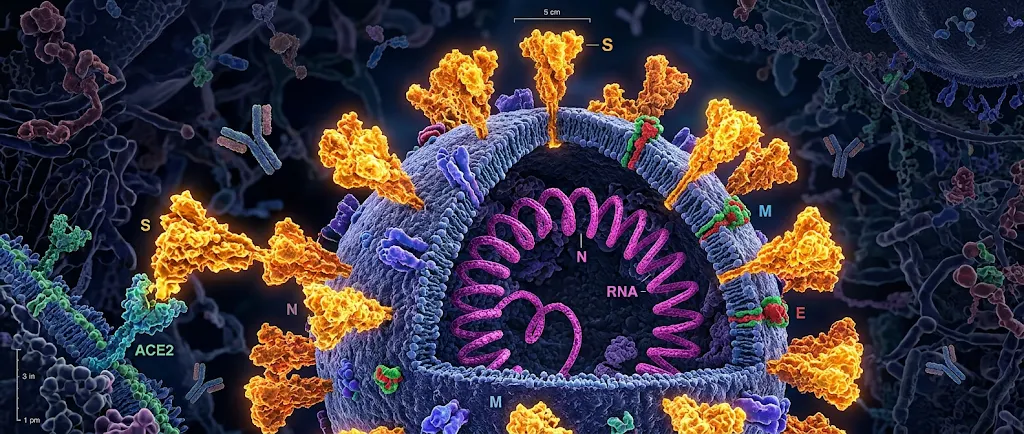
A new SARS-CoV-2 variant called PJ.2.1 is drawing global attention this autumn. Its first documented sample was collected in Ontario, Canada, on May 2, 2026, and it has since been detected in the US, Spain, France, Israel, Singapore, Australia and New Zealand (The Economic Times).
Why is it called a “jump” variant?
PJ.2.1 descends from the MC.10.1 lineage, which traces back to JN.1. Scientists call it a “saltation” or “jump” variant because it appeared with more than 25 spike mutations at once instead of gaining them gradually (The Economic Times). One theory is that it developed in an immunocompromised patient in Ontario (164.ru).
How fast is it spreading?
Public Health Ontario found PJ.2.1 in 25.2% of sequenced samples from September 20 to October 17, up from 16.9% in the previous four weeks (The Economic Times).
PJ.2.1 symptoms
There is no symptom profile unique to PJ.2.1 (Moneycontrol). The WHO notes that COVID symptoms overlap with flu and colds: fever, cough, sore throat, runny or blocked nose, headache, muscle aches and severe fatigue, sometimes with digestive problems, shortness of breath or changes in taste and smell (Health and Me). Only a test can tell which virus you have.
Is it more dangerous?
So far, no. As of November 8 there was not enough evidence that PJ.2.1 causes more hospitalizations, severe disease or deaths. Lab data also suggest little immune escape: its sensitivity to antibodies was as good as or better than other variants tested (The Economic Times).
How to protect yourself
Check whether you are eligible for an updated COVID vaccine, test when you have symptoms, stay home when sick and consider a mask in crowded indoor spaces during winter.
FAQ
Is PJ.2.1 a new pandemic? There is no evidence of that; the WHO is monitoring it.
Do home tests detect PJ.2.1? Rapid tests detect COVID in general, not specific variants.
Do vaccines work against it? Early lab data show antibodies still recognize it well; real-world data are pending.
